by Skye Carbin
MetroHealth is one of the first rehabilitation clinics in Ohio to begin using a new device that delivers transcutaneous spinal cord stimulation to improve arm and hand function in people with spinal cord injury (SCI).
Since March, select individuals getting outpatient occupational therapy at The MetroHealth Rehabilitation Institute (MHRI) have been using the ARC-EX System, developed by medical technology company Onward Medical. MetroHealth is one of 110 clinics in the United States and around the world with ARC-EX units, according to the company.
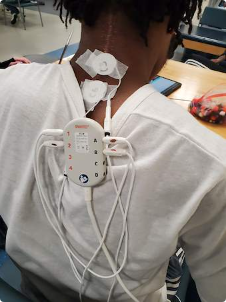
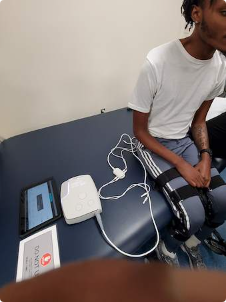
The technology resembles functional electrical stimulation (FES), which stimulates nerves or muscles that don’t move voluntarily following injury. With ARC-EX, however, pads are placed on skin directly over the spinal cord. The delivered electrical stimulation improves the movement in muscles that patients retain control over.
As one of 18 federally designated Spinal Cord Injury Model Systems in the U.S. and one of 15 rehabilitation centers in the U.S. to be named a Rehabilitation Innovation Center, MetroHealth is on the forefront of spinal cord injury medicine, said Ben Petrie, MD, Spinal Cord Injury Director at MHRI.
“This is an exciting new frontier,” he said. “We’re in the early phase of integrating this technology into our patient care.”
Patients eligible for ARC-EX must meet the following criteria:
- Have an incomplete SCI that spans the C2-C8 cervical vertebrae, which affects the neck, arm and hand region
- Be between the ages of 18 and 75
- Have a grade of B, C, or D on a spinal cord injury assessment exam
A clinical trial called Up-LIFT enrolled 65 participants in the United States, Canada, United Kingdom and The Netherlands. Over a two-month period, participants received a combination of hand therapy and ARC-EX stimulation.
The results of the trial, designed to show safety and effectiveness, led to the Food and Drug Administration (FDA) granting clearance to the makers of the device in December 2024 to make it available in the United States. ARC-EX is the first system approved by the FDA for non-invasive spinal cord stimulation specifically for SCI. The FDA approved ARC-EX for home use in November 2025.
James Wilson, DO – Dr. Petrie’s predecessor – reached out to Onward Medical.
“He was invested in the research and science backing this therapy and was passionate about bringing the ARC EX to those with cervical spinal cord injuries receiving care at MetroHealth,” said Jessie Huschart, Onward Medical Therapy Consultant.
About a year ago, Onward Medical reached out to Dr. Petrie after his arrival to ask if MetroHealth could identify patients who might benefit from ARC-EX.
Carlen Morris, a high school senior when he was seriously injured in a car accident in October 2023, was asked if he would be interested in trying it out. He said yes.
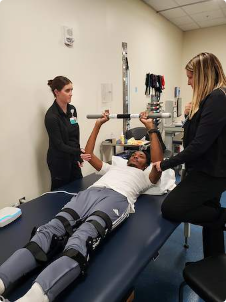
Initially told he’d never walk again and would have total paralysis of his arms and legs, Carlen was transferred to MetroHealth. He spent two months in inpatient physical and occupational therapy. In May 2024, he walked across the stage with assistance at his high school graduation.
During his first round of outpatient therapy (89 sessions in 2025), Carlen made steady progress.
Last summer and fall, representatives from Onward Medical visited MetroHealth several times. On two of those visits, they held two separate presentations – one for physicians and residents, one for occupational therapists – demonstrating with Carlen how ARC-EX could be incorporated in OT sessions.
After experiencing ARC-EX for the first time, Carlen said he could control his hand movements more, especially in his dominant left hand.
Megan Anderson, MS, OTR/L, Lexi Emerick, MOT, OTR/L, and Mary Harley, OTR/L, are now using ARC-EX with their patients. Anderson re-evaluated Carlen in April before he resumed therapy. Since then, he’s had six 90-minute OT visits.
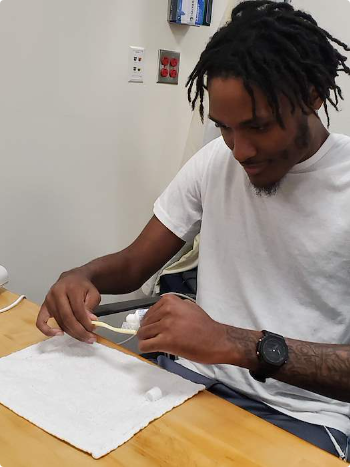
During a recent session, Carlen, now 20, did a series of pinching, twisting and squeezing exercises to practice his fine motor skills.
“He did show progress on his own before, but watching him in therapy with ARC-EX, he’s doing so much more,” Anderson said. “He’s now able to open toothpaste and squeeze it onto his toothbrush, something his hands were unable to perform prior to the use of ARC-EX.”
Movement and strength in Carlen’s hands and arms continue to improve.
“I have looser movement on the right side, but more control on the left side,” he said after using the ARC-EX system for half of his 90-minute session with Anderson.
Carlen’s goals include being able to do more things without assistance – like getting food out of the refrigerator and dressing himself – and driving again.
“There’s so much variability in spinal cord injury, both in terms of the deficits caused by the injury and in terms of a patient’s goals for recovery,” Dr. Petrie said.
“Some may really value ARC-EX for its ability to recover hand function. Others may appreciate more gross motor function, like being able to give someone a hug,” he said.
“You have to respect that all spinal cord injuries are different and everyone has different priorities when it comes to recovering from a spinal cord injury.”
